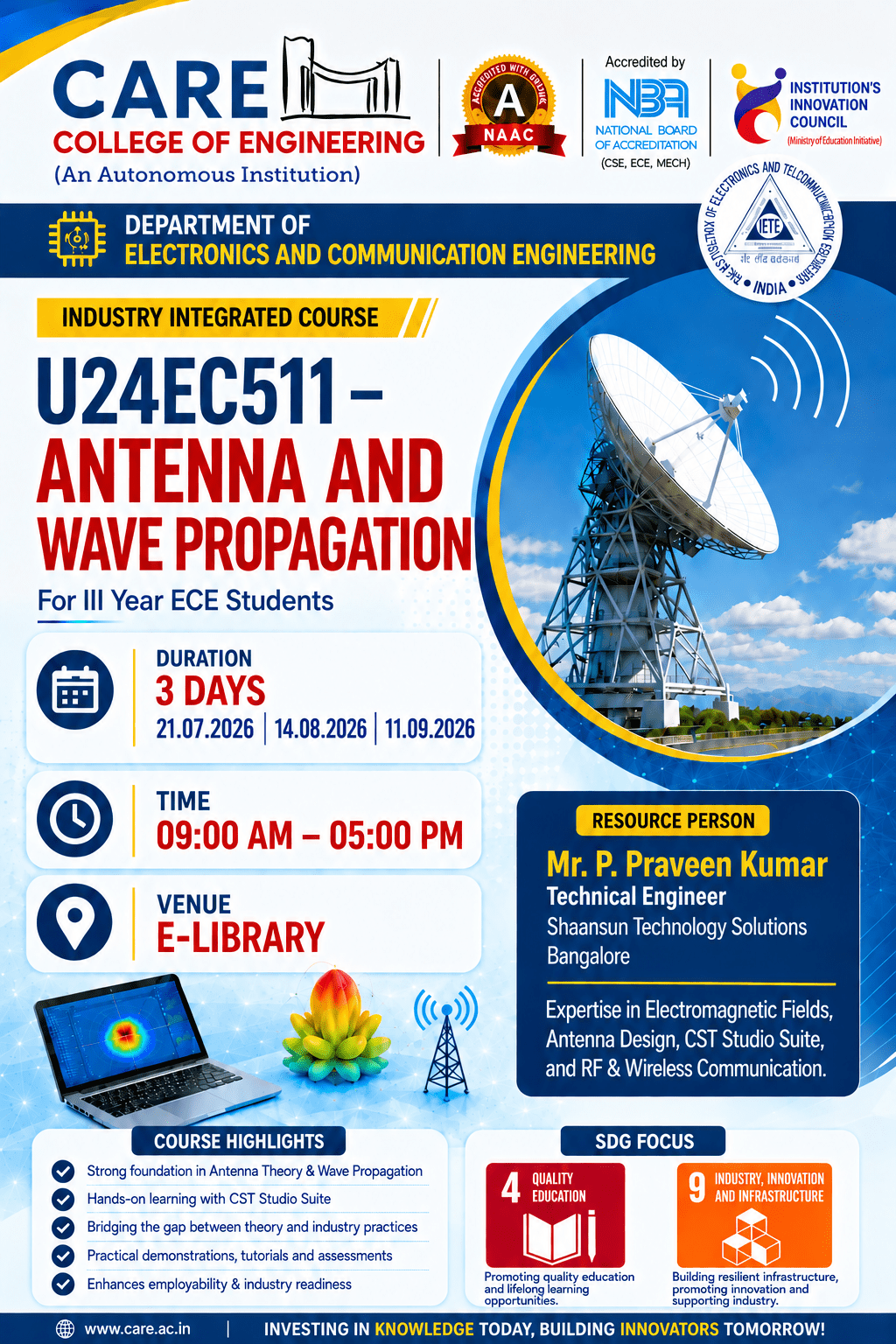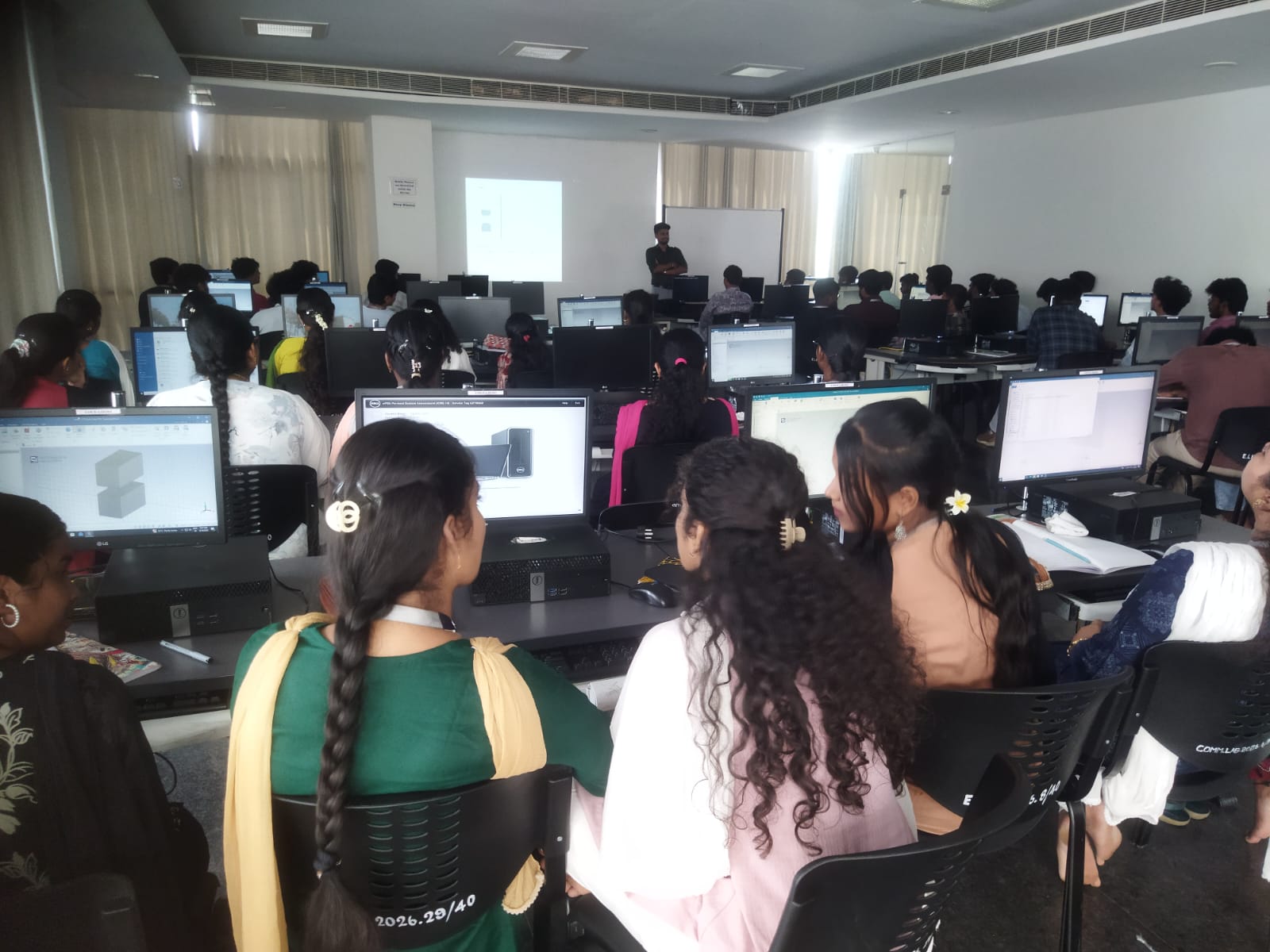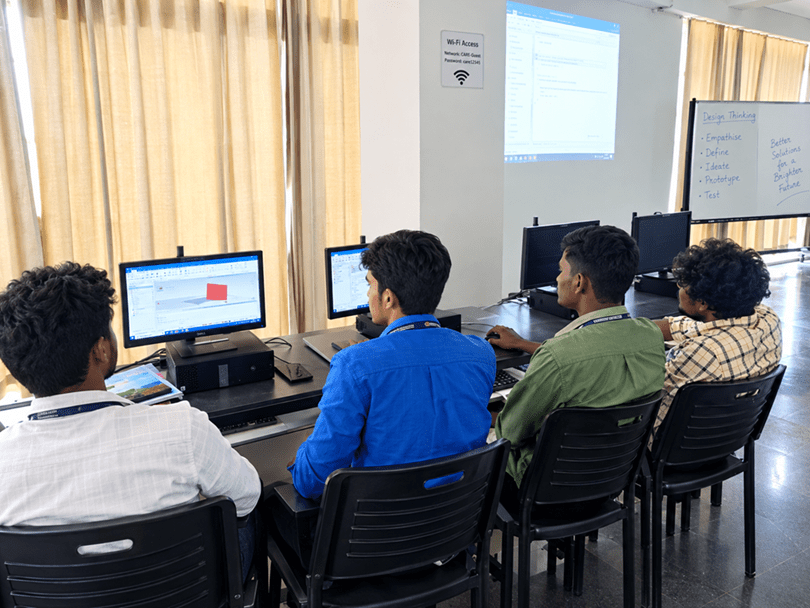
The Department of Electronics and Communication Engineering (ECE), CARE College of Engineering, organized a 3-day Industry Integrated Course on U24EC511 – Antenna and Wave Propagation for III Year ECE students (V Semester) on 21 July 2026, 14 August 2026, and 11 September 2026, covering both FN and AN sessions. The programme was coordinated by Mrs. R. Deepalakshmi, AP/ECE, and provided students with an intensive industry-oriented learning experience focused on antenna theory, analysis, simulation, and practical design.
Mr. P. Praveen Kumar, Technical Engineer, Shaansun Technology Solutions, Bangalore, served as the industry expert and provided valuable insights into the practical aspects of antenna engineering and RF/wireless communication systems. The sessions were designed to bridge theoretical concepts taught in the classroom with practical antenna engineering practices, simulation-based analysis, and contemporary industry requirements.
The first day focused on the fundamental concepts of antenna radiation, including the physical concept of radiation, near- and far-field regions, fields and power radiated by an antenna, antenna pattern characteristics, gain and efficiency, aperture and effective area, antenna noise temperature and G/T. Students were also introduced to important practical concepts such as impedance matching and VSWR, enabling them to understand the parameters used to evaluate antenna performance.
The second day covered various antenna array concepts, including two-point element antenna arrays, horizontal patterns in broadcast arrays, linear arrays, multiplication of patterns, phased arrays, adaptive arrays, and binomial arrays. Through technical illustrations and simulation-oriented demonstrations, students gained an understanding of how element arrangement, spacing, amplitude, and phase influence the overall radiation characteristics of an antenna array.
The third day focused on aperture and practical antenna structures, covering radiation from rectangular apertures, uniform and tapered apertures, horn antennas, reflector antennas, slot antennas, and microstrip patch antennas. The sessions highlighted the operating principles, structural characteristics, radiation behaviour, and practical applications of different antenna configurations used in modern communication systems.
Outcome of the Programme
The Industry Integrated Course enhanced students’ practical understanding of antenna and wave propagation concepts by connecting theoretical principles with industry-oriented applications. Students developed greater familiarity with the analysis, design, simulation, and performance evaluation of antennas, particularly in areas such as radiation characteristics, impedance matching, VSWR, antenna arrays, aperture antennas, horn antennas, reflector antennas, slot antennas, and microstrip patch antennas.
The simulation-based activities strengthened students’ technical problem-solving, analytical thinking, antenna design, simulation interpretation, and practical implementation skills. Students gained hands-on exposure to evaluating antenna parameters and understanding how design modifications influence resonant frequency, radiation pattern, gain, efficiency, impedance matching, and bandwidth.
The direct interaction with the industry expert also provided valuable insights into practical antenna engineering, RF and wireless communication applications, industry practices, and the technical skills expected from electronics and communication engineers. The programme encouraged students to apply theoretical antenna concepts to practical engineering problems and strengthened their confidence in using simulation tools for antenna analysis and design.
Overall, the programme contributed to improving students’ technical knowledge, practical skills, employability, and industry readiness in the field of antenna and wireless communication engineering. The initiative also supported Sustainable Development Goal (SDG) 4 – Quality Education through experiential and industry-linked technical learning and SDG 9 – Industry, Innovation and Infrastructure by promoting practical engineering skills, simulation-based learning, and exposure to modern RF and antenna technologies.